Mission Statement for the United Nations International Day of Older Persons
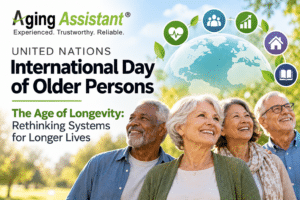
Supporting longer, healthier lives through inclusive systems and policies.
The 2026 United Nations International Day of Older Persons (UNIDOP) will explore one of the defining transformations of our time: humanity is living longer than ever before.
Global life expectancy has increased steadily over more than seven decades and is projected to continue rising through mid-century. Yet in 2019, the gap between global life expectancy and healthy life expectancy stood at 9.6 years, a gap that has widened since 2000, reflecting the growing burden of noncommunicable diseases. Longer lives are bringing greater attention to how health, social and economic conditions, and human rights are experienced across the life course.
Longevity intersects with health systems, labor markets, social protection frameworks, education systems, housing and infrastructure planning, and fiscal sustainability in ways that are deeply interconnected and cannot be addressed in isolation. Where years of life are lived in good health and supported by inclusive labor markets and effective social protection systems, longer lives can generate what has been described as a longevity dividend, reflecting the gains that arise when sustained health, productivity and participation accompany extended life spans.
Conversely, where gains in life expectancy are not accompanied by improvements in healthy life expectancy, older persons may spend more years in poorer health, limiting their functional ability, well-being, autonomy and participation. This underscores the need for responsive health systems, care provision and public financing arrangements that support well-being across longer lives.
Outcomes vary significantly across and within countries, reflecting deep inequalities in social, economic and environmental conditions that accumulate across the life course. Persistent misconceptions about aging, including assumptions that chronological age determines ability or that population aging inevitably constrains economic growth, can distort policy design and reinforce the very outcomes they purport to describe.
Older persons should be recognized as active contributors to society rather than passive recipients of care, and policies should reflect the diversity of aging trajectories and the capacities and contributions in later life. Addressing these realities requires policy approaches that recognize the linkages between wellbeing, productivity and financial resilience across the life course.
The Madrid International Plan of Action on Aging (MIPAA), adopted in 2002, remains the cornerstone of international efforts in this regard, alongside a growing international momentum to strengthen the human rights framework for older persons. This year’s commemoration, The Age of Longevity: Rethinking Systems for Longer Lives, invites Governments, civil society, the private sector, researchers, and older persons.
If you or an aging loved one is considering Home Care in Fairfield, CA, please contact the caring staff at Aging Assistant today at (916) 897-4752

